
INDUSTRY SECTORS WE SERVE





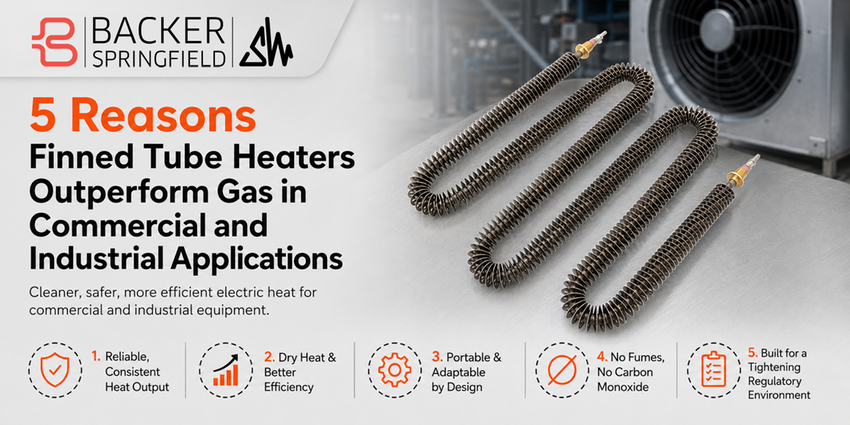
5 Reasons Finned Tube Heaters Outperform Gas in Commercial and Industrial Applications
Finned tubular heaters expand on the standard tubular design by winding metal fins around the heating tube, increasing surface area for faster, more efficient heat transfer — without the fumes, carbon monoxide risk, or compliance burden that come with gas. This technology offers a cleaner approach to electric heating for design and technical staff in need of optimizing the performance of their commercial or industrial equipment.
- Reliable, Consistent Heat Output
Fins are tension-wound directly onto the heating tube and spot-welded at the ends, forming a mechanical bond that holds through repeated thermal cycles. That structural integrity prevents fin shift, loosening, or delamination over time — keeping heat transfer consistent and rated output stable from the first cycle to the last. In other words, the heater continues performing according to its intended design, even after withstanding years of repeated thermal cycling and operation. The result is fewer hot spots, less unplanned downtime, and lower long-term maintenance costs.
2. Dry Heat and Better Efficiency
Finned tube heaters produce clean, dry heat with no combustion byproducts, so they introduce no moisture or fumes into your process environment. The expanded fin surface transfers heat to surrounding air faster and with less energy input than a bare tube — and when paired with forced airflow, that efficiency compounds. Air moving across the fin surface absorbs heat rapidly, making these heaters well-suited for food warming equipment, drying systems, and duct heating assemblies where humidity control matters as much as temperature consistency. This combination of dry heat and efficient airflow helps improve heating response while reducing the risk of moisture-related process issues.
3. Portable and Adaptable by Design
Available in straight-rod and bent configurations across multiple sheath diameters, finned tube heaters fit a wide range of spatial constraints — with sheath material, fin geometry, and end seal all configurable for your application. Whether you are designing food-warming equipment like holding cabinets or industrial blower units driving hot air across large working spaces, that adaptability extends across both commercial and industrial uses. Some other utilities include space heating in hotel room wall units, portable commercial heaters, and forced-air HVAC assemblies.
4. No Fumes, No Carbon Monoxide
Gas combustion produces carbon monoxide — a serious hazard in enclosed spaces that adds cost and complexity through ventilation requirements, CO detection systems, and ongoing compliance overhead. Electric finned tube heaters eliminate combustion entirely, producing no exhaust, no byproducts, and no open flame. This denotes fewer safety considerations during system design and a simpler path to regulatory compliance. The result is clean, controllable heat that simplifies both system design and code compliance across food service, medical, and occupied commercial environments.
5. Built for a Tightening Regulatory Environment
Gas regulations are tightening across North American and international markets, with some jurisdictions already restricting gas appliances in new commercial construction. Electric-finned tube heaters sidestep combustion-specific requirements entirely, reducing the risk of non-cost-effective redesigns as codes continue to evolve. Choosing electric today can also help position future product designs according to shifting market requirements. That said, this flexibility gives your equipment broader installation options — now and as regulatory requirements develop further.
Backer Springfield engineers finned tubular heaters from the ground up, refining the tension winding, spot welding, and fin geometry that determine real-world performance across your application's full-service life. From concept through production, our team supports yours to engineer finned tubular heaters around your equipment’s space constraints, airflow or moisture specifications, mounting configuration, and overall operating environment.
BACKER BHV AB · FABRIKSGATAN 11 · SE-280 10 SÖSDALA · TEL: +46 (0)451-66100 · [email protected] · Corp. reg: 5560530569